
Over 19,276 exercises, and you only need 28.
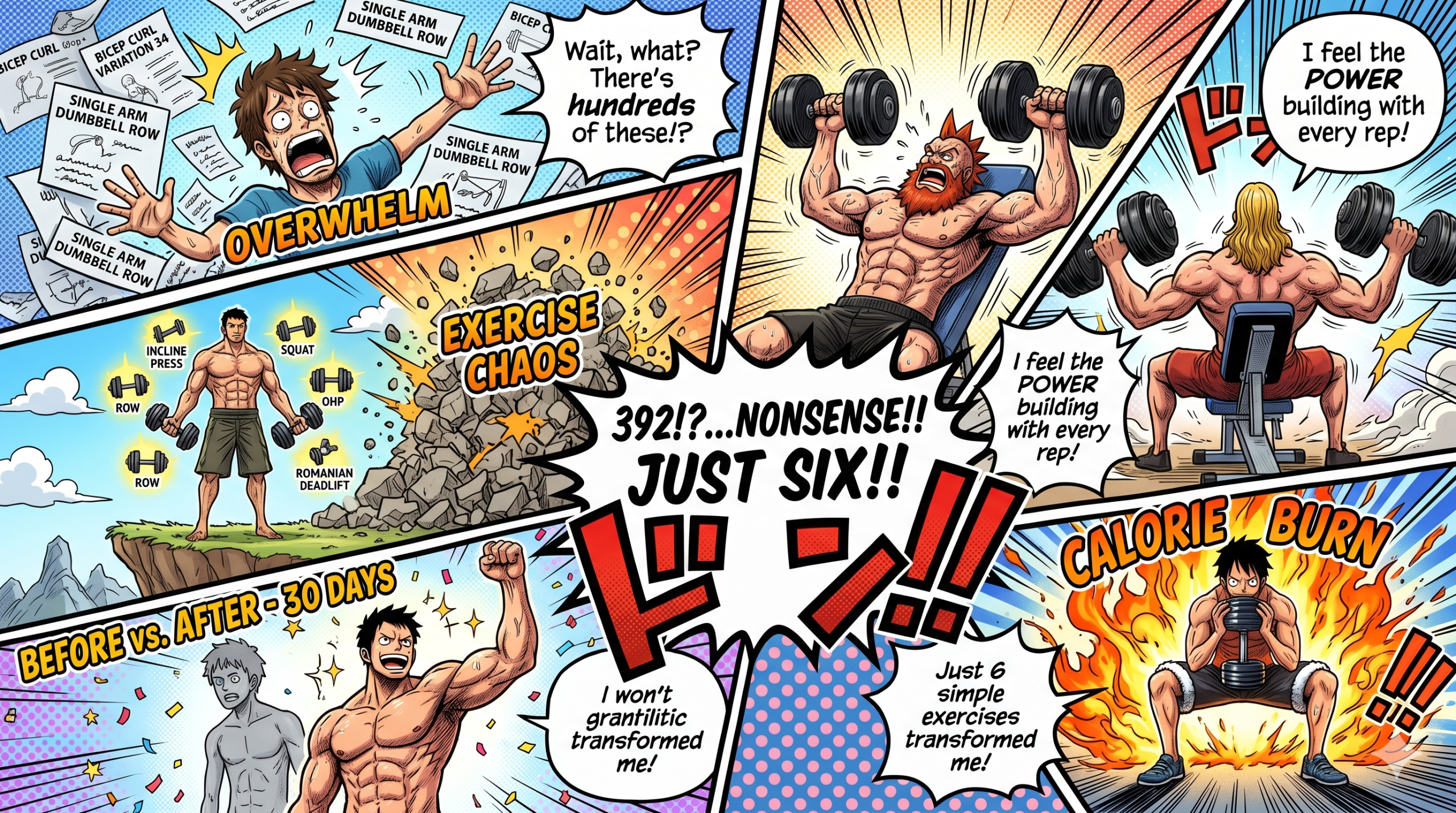
> “80% of the results come from 20% of the efforts.” — Tim Ferriss
—
I remember it like it was two decades ago — because it was two decades ago.
I was a young kid wandering through the library, searching. Searching for what? No idea. I didn’t even know what topic I was after. I just walked around, seeing what was there.
Whenever something caught my eye, I’d grab a book. Most of the time it was self-improvement — the kind of stuff I could actually apply to my life.
So that’s what I did. I borrowed the book. Read it. Applied what was useful. Was it always life-changing? Sometimes yes, sometimes no. But either way, I walked away with something.
—
Now contrast that with today.
Libraries? Barely getting visitors. The internet made sure of that. Information that used to take hours to find is now a 10-second Google search away.
Sounds like a godsend, right?
In many ways it is. But with every massive upside comes a massive downside.
Because of the internet, the real problem isn’t a lack of information — it’s too much of it.
And nowhere is this more true than in fitness.
The amount of fitness content out there is insane. It keeps growing exponentially. People nowadays binge-watch hours of fitness videos before they’ve ever touched a weight. They get mentally obese before their fitness journey even starts.
They want to know the best exercise for every muscle group. Every variation. Every hack.
The result? Overwhelm. And they quit after a few months — if that.
I see it all the time in the gym. And honestly? I was the same.
I used to search endlessly for the “best” exercise for each muscle, convinced that one perfect movement would unlock everything.
After 15 years of training, here’s my big conclusion:
You can stick with the basics and build any physique you want.
Mind-blowing, I know. Someone give me an award.
—
But seriously — this applies to any skill, not just fitness.
I’m also a massive nerd and passionate about coding. Fitness and coding couldn’t be more different on the surface. But the same principle applies to both:
Master the basics, and you’ll excel.
Too many people jump from exercise to exercise, chasing the magic one. There is no magic one. And in the process, they make fewer gains and overthink every workout.
The trick is to master the fundamentals so well you can do them flawlessly with your eyes closed.
You know the Bruce Lee quote:
> “I do not fear the man who has practiced 10,000 kicks once. I fear the man who has practiced one kick 10,000 times.”
—
The only exercises you’ll ever need
Before we get into the list — a quick note on why knowing your target muscle matters:
1. So you know what you’re actually working
2. To avoid overtraining the same muscle, which leads to imbalances and injury
These are the exact exercises I’ve used for the past five years. Nothing more.
Chest
- Bench Press
- Incline Dumbbell Press
- Cable Flys
- Cable Flys High to Low
- Machine Press
Back
- Lat Pulldown
- Lat Pulldown Close Grip
- Bent Over Barbell Row
- One Arm Dumbbell Row
- Seated Cable Row
Legs
- Barbell Back Squat
- Leg Extension
- Stiff Leg Deadlift
- Lunges
- Calf Raises
- Hip Thrust
Shoulders
- Overhead Dumbbell Press
- Dumbbell Side Lateral Raise
- Dumbbell Rear Delt Raise
- Dumbbell Shrugs
Arms
- Dumbbell Bicep Curl
- Dumbbell Hammer Curl
- Dumbbell Skull Crushers
- Cable Tricep Pushdown
Abs
- Cable Rope Crunch
- Hanging Leg Raises
That’s it. 28 exercises. That’s all you need.
—
How many sets and reps?
Keep it simple:
✅ 4 sets of 12 reps per exercise
✅ At least 3 exercises for bigger muscle groups (chest, back, legs)
✅ 1–2 exercises for smaller muscle groups (arms, abs)
The most important thing is consistency. The simpler you keep it, the easier it is to stay consistent.
Next up: form.
It takes time to get right. Speed it up by:
📌 Watching yourself in the mirror while lifting
📌 Recording yourself and reviewing your technique
📌 Hiring a personal trainer for a few sessions to dial it in
Consistency and form go hand in hand. No consistency means no reps to practice form. No form means no foundation to build on.
Stick with the basics.
—
Objections
“Won’t my muscles adapt and stop growing?”
Partially true — if you do the exact same thing with zero progression, growth slows. But you don’t need new exercises to keep progressing. You need:
✅ Progressive overload (increase the weight)
✅ More reps with lighter weight
✅ Supersets
✅ Drop sets
✅ Slow, paused reps
Any of these will keep your muscles growing without ever changing the exercise.
—
“Doesn’t knowing more exercises mean more gains?”
No.
Perfection beats variation every time.
The guy doing four different bicep exercises half-heartedly gets nothing. The guy who masters one bicep curl? He’ll blow past everyone.
It’s about mastering the movement and actually feeling the muscle work. That’s impossible if you’re constantly jumping around.
I can grow muscle doing a 5 lb bicep curl — because I know the movement inside and out.
Look at any top bodybuilder. What do they focus on? Technique and form on basic compound lifts. Not fancy Instagram exercises. The fundamentals.
—
Final thoughts
Stop overcomplicating it.
The information age makes it way too easy to hoard knowledge instead of taking action. Don’t fall into that trap.
Master the basics. Stay consistent. Watch what happens.
If you want a structured workout plan covering all of this, I’ve got a free PDF — three plans for different fitness levels. Sign up for the newsletter to get it.
